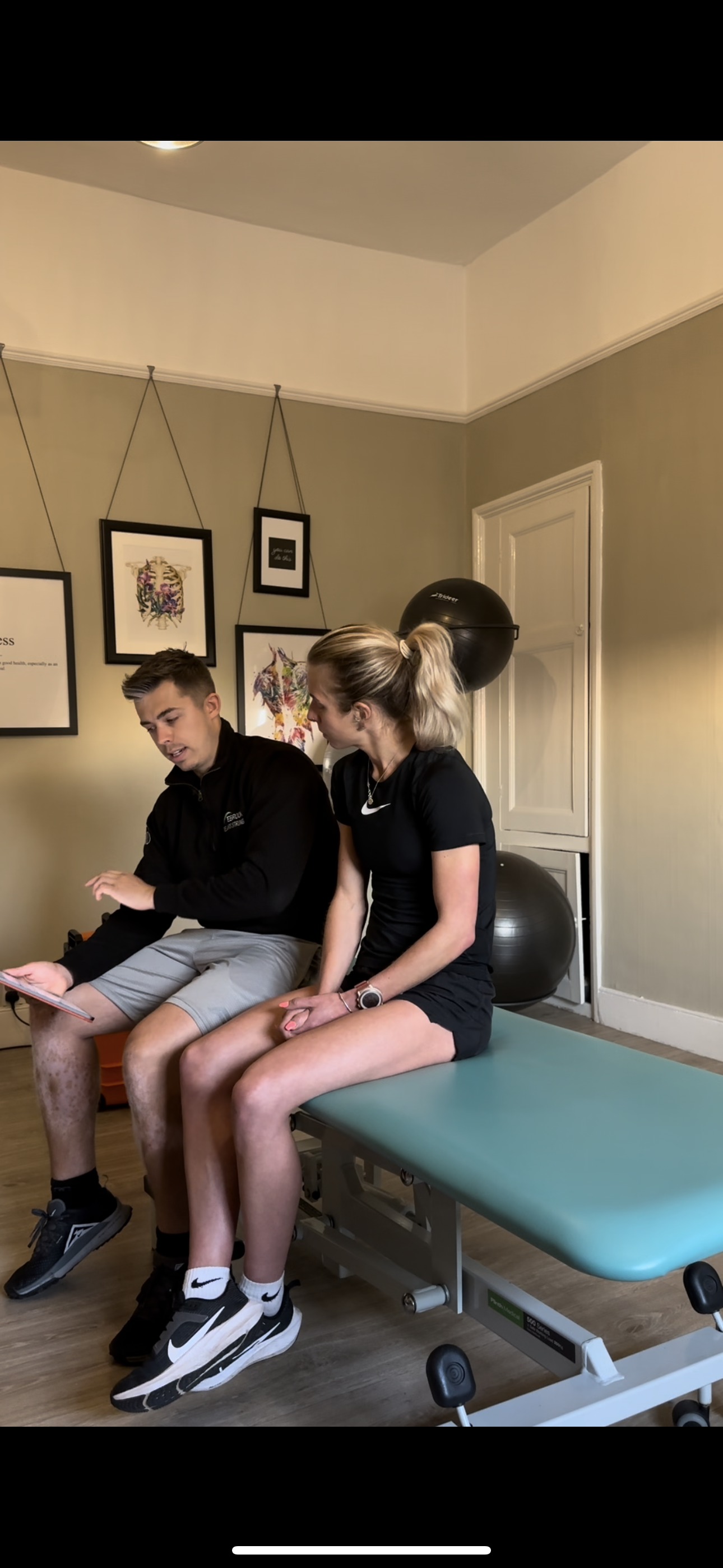
Just before the Midland Road Relays. I welcomed Hayley Carruthers to her first Vald testing appointment. Hayley was seeking vital insights as to how her strength and range were impacting her race performance, both as an individual and in her efforts as a team with Tipton Harriers.
Hayley Carruthers is an elite level runner competing for England at the Seville Marathon in 2019. Since then, Hayley has overhauled her training, conditioning and nutrition to become a healthier athlete. Like many runners, Hayley already has a training program in place with the aim to achieve faster and faster times in the events that she attends. These general methods of training are great if you can see results; if the times get faster, perfect the training is working! If the times get slower, maybe this training isn’t the right fit and a different approach is needed. The downside to this training is that it is a very generalised approach, exercises are performed in the hope that it leads to an improvement to the athlete’s overall ability to perform, but what if there was an underlying limiting factor that the training wasn’t benefiting, and it was holding the athlete back.
This is where the Vald testing comes in. With the Vald dynamo, Hayley and I were able to analyse specific unilateral movements both to determine any asymmetries or weaknesses. The Dynamo enables us to examine strength concentrically and eccentrically, giving super accurate data, which we can plot against both an athletic and normative data set to show exactly how fast and strong Hayley is, compared with her peers.
Using the Vald Dynamo I discovered that Hayley had a significant asymmetry when performing a prone (lying on the front) hip extension. Hayley’s right leg was noticeable stronger on the results provided by the dynamo, Hayley stated that this could be due to a former injury in her left hip which was no longer bothering her or giving her any pain, however it is clear after testing with the Dynamo that this former injury is still limiting Hayley’s running performance.
After some targeted training Hayley and I will retest the movement to determine whether the training is reducing the asymmetry. Being able to use this technology to pinpoint problem areas is revolutionary, giving me as a practitioner the tools to accelerate improvements to an athletes training or to speed up the recovery of someone undergoing rehabilitation after an injury. It really is changing the landscape of clinical practice for athletes.
After Hayley and I had tested for all the major movement with the dynamo, we headed over to Ebrook Fitness Gym to use the force decks (A pair of uniaxial forced plates). The force decks were used to test two movements; the counter movement jump (CMJ) the perform this movement the individual places their hands onto their hips, to eliminate the upper body, quickly bends their legs and jumps as high as they can. The force decks can use information such as airtime, to calculate jump height. Due to the force decks being two separate plates they can also measure the amount of force coming through each individual leg when taking off and when landing.
The next test caried out was an isometric mid-thigh pull (IMTP). The individual stands on the force decks and attempts to pull an immovable bar as hard as they can. This test simulates the top end of a deadlift and is used to determine the individual’s maximal strength.
The CMJ and IMTP can then be compared with each other to find the individuals Dynamic Strength Index (DSI). This value tells me as a practitioner how good the individual is at converting their maximal strength into ballistic strength and this can determine the recommended training program the individual should utilise to improve their ballistic strength. DSI is calculated with the following formula: CMJ divided by IMTP if the value is below 0.6 this shows the individual isn’t efficient in converting their maximal strength into a ballistic jump and should therefore target plyometric movements in their training. If the value is 0.6 – 0.8 then this shows the individual is in the expected range and should continue with concurrent training. Finally, if the reading is above 0.8 then the individual is extremely efficient in using their maximum strength in their ballistic movements and therefore should train for maximal strength to increase their maximum strength further.
Hayley’s CMJ was 1319N and IMTP was 1454N. This puts her DSI at 1319N/1454N = 0.9 this means Hayley is extremely good at using her maximum strength effectively and so therefore should prioritise maximum strength training.
Forceplate testing is useful in analysing runners specifically because the way they relate to the ground during running is a massive determinant factor in speed and injury risk. If a runner can’t reabsorb and reuse ground force, their running will be inefficient, costing them more energy, and taking seconds off their times in races.
Having these metrics will inform Hayley’s training going forward and provide us with a timestamp to compare her future performance to.
Runners of all abilities can benefit from VALD testing because it highlights areas that could be; holding you back from progression, or causing you that recurring pain. VALD testing with Ebrook Osteopathy can open the door to new PB’s or a pain free run.