Your posture becomes the shape you decide to position your body throughout the day. So if you’re working at a desk or drive for prolonged periods time it’s most likely you’re going to develop rounded shoulders.
Quick test – stand up with your arms at a natural position by your sides, look down – which way are your thumbs facing? If they are facing one another it’s showing positive for rounded shoulders.
While rounded shoulders are often the result of slouching in front of a desk, they can also result from how you work out at the gym. Either way, this posture can cause pain and aching in the upper back, and have a knock on effect on the rest of the spine. The rounding of shoulders also encourages the head to extend forward, which can cause neck pain.
What is happening with your muscles?
Generally, the anterior musculature has become tight or overactive in relationship to the posterior musculature. Muscles such as Pectoralis major and minor, anterior deltoid, subscapularis and serratus anterior are the anterior muscles that are pulling the shoulders forward. In relationship to the posterior muscles i.e. Rhomboids, Posterior deltoids, mid/lower trapezius and rotator cuffs these muscles are weak and not pulling the shoulders backwards as they should be.
Think about it this way. There’s a tug-of-war battle between the muscles at the front and back of the shoulder and currently the front team is winning!
How can this be corrected?
There are many ways to correct rounded shoulders, and often responds very well to a combination of different methods. First off, the aim is to discover why you might have rounded shoulders. If you find yourself in front of the computer most of the day hunched forward, that may be the reason why. Another reason is if you’re into sports that require a lot of pushing movements from the shoulder such as powerlifting or bodybuilding, squash and tennis, then correcting the muscle imbalances between the front and back of the shoulder will help with rounded shoulders.
But regardless of why you may have rounded shoulders, there are specific exercises that will strength the weaker muscles of the shoulder and lengthen the hyperactive muscles. The first stage of treatment would be performing different shoulder exercises and stretches to help re-balance the strength of the muscles that influence the shoulder joint.
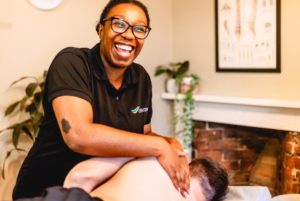
If exercising and stretches show little to no improvement, alternative methods such as soft tissue therapy. Soft tissue therapy is the manipulation of different soft tissues in the body. Soft tissue consist of structures such as muscle, ligaments, tendons and fascia. In rounded shoulders, the anterior compartment of the shoulder and torso are often tight and pulls the shoulder forward and inward. Reversing the process by lengthening and stretching the anterior compartment will help the shoulders relax and bring the shoulders back into the proper position.