
Gaining insight into your body’s strengths and weaknesses is one of the most valuable actions you can take as a developing athlete or sportsperson.
Ebrook Osteopathy and Sports Clinic have invested in performance testing technology that can quantify the differences in power, range, endurance and precision for different muscle groups and movements, allowing your practitioner to interpret that data and give more effective treatment and rehabilitation plans. Without these measurements, the treatment plan is more open to human error, reducing the efficacy of treatment and prolonging injury time.

The Dynamo is a hand-held device that allows our practitioners to perform hundreds of strength and range of movements tests, collating the data against a patient’s past performance and a massive normative database, which can be compared against age, sports, and more. Dynamo testing gives us an accurate baseline for many aspects of performance and rehabilitation plans.
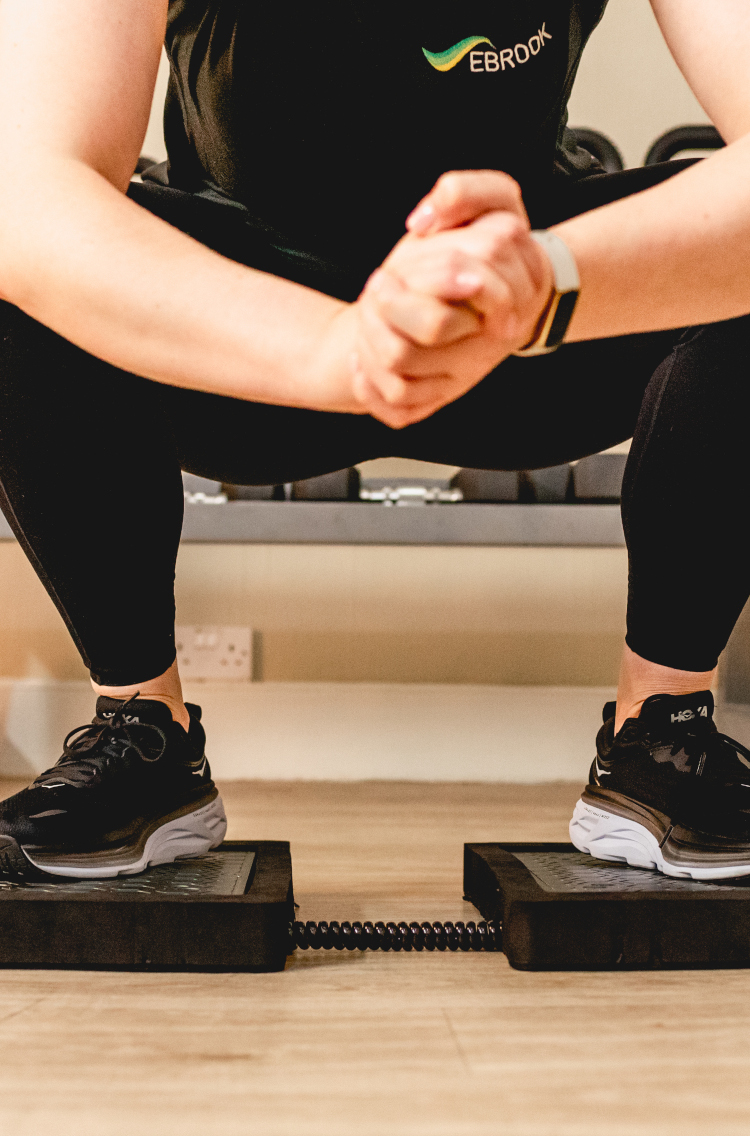
Forcedecks measure how you interact with the ground. Take off, landing, force production, absorption, balance and efficiency of movement can all be measured with a Forcedecks test. Information from these tests can reveal vulnerabilities, which we can train into strengths – improving performance and reducing injury risk.
The VALD Humantrack is the next level in movement technology, and our most complete movement tracking system. Capable of assessing compound and multi-joint movements, these tests give us the best overview of your movement competency, stability and flexibility, with a massive base of data to draw upon.
Book a Testing Bundle Appointment where your practitioner can perform multiple tests with more than one of our testing systems in one session.
In the case of running, we often need to assess in a slightly different way. Running itself as a sport, or as a component of a sport such as football, rugby, hockey or tennis, is more complex than we might initially recognise. Inefficiencies in running technique can show themselves in slower paces, technical mistakes, or repeated injuries.
Gaining insight into lost forces or gait inefficiencies can help to optimise your running technique. Do you loose energy in an upward bounce? Is there an over rotation in your arm movements? How much of your forward momentum is lost to over engagement of the hamstring brake? All these questions are difficult to answer without the proper assessment strategies, even for experienced coaches.
Our practitioners have done additional courses in gait analysis and injury prevention for runners to make sure they can offer useful insight into reworking your running technique.
The gait analysis appointments are carried out from our Sutton Coldfield site, where your practitioner will meet you at the clinic. To begin, they will sit with you and discuss any concerns you have about your running style, before taking you across the road (3 min walk) to the Ebrook Fitness Studio.
Here, they will film your running style on the treadmill and perform movement screening testing on the DMS (Dynamic Movement System), slowing down the footage to make sure they are able to highlight key points to you.
A second run on the treadmill will see them coach you on these key points of gait, so that you can begin to physically process your gait corrections.
Moving forward, your practitioner may suggest a re-assessment in a few weeks, to make sure these positive changes stick. It typically takes 6-8 weeks to make a change to a person’s running style, so we like to work with people over a slightly longer time period to ensure these positive changes last.

Anyone looking to improve their athletic performance is a good candidate for strength and range testing. Runners, swimmers, cyclists, golfers, football and rugby players, tennis and other racket sports players, hockey players – the list is endless!
People with muscular pain or injury may still like to be tested to give a better insight to the root of their issues. Our practitioners often use strength testing to try and identify which parts of the body need some extra help when it comes to planning their rehabilitation exercises. We can use our Forcedecks for people with balance or coordination issues (like neurological disorders, Parkinson’s Disease, or post-stroke recovery) to help gain insight to the speed and completeness of their recovery or for monitoring their falls-risk.
Yes! This is a great example of when it can be really important to test your strength and symmetry. Your practitioner will be able to identify patterns of compensation in your body through the testing, and help you to work on optimising your movement to best aid your recovery.